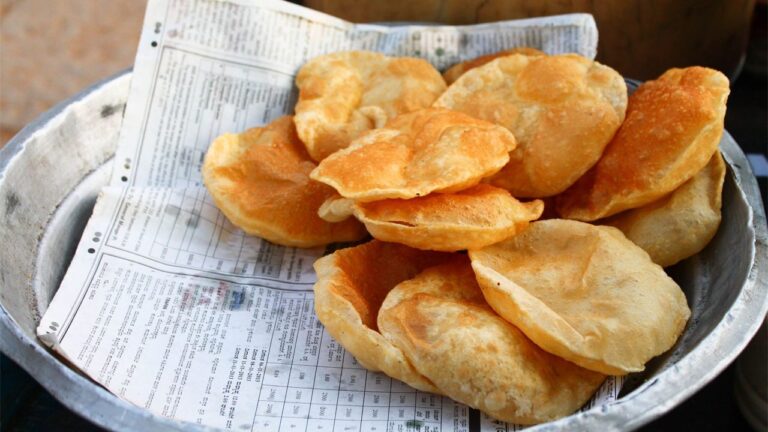
Puri vs bhatura is a choice between two deep-fried Indian breads that both balloon in hot oil. Puri is the small one, made from plain whole wheat dough. Bhatura is the big, stretchy one, made from raised white-flour dough and best known from chole bhature.
The flour and the rise explain nearly everything else: size, chew, how long they take to make and what goes on the plate beside them.
Quick answer
What is the difference between puri and bhatura?
Puri is an unleavened whole wheat bread, fried in small rounds and eaten with potato curry, chickpeas or sweets. Bhatura is made with white flour and yogurt, raised with yeast, fermentation or baking soda, rolled larger and chewier, and eaten with chole. Both puff when steam is trapped inside.
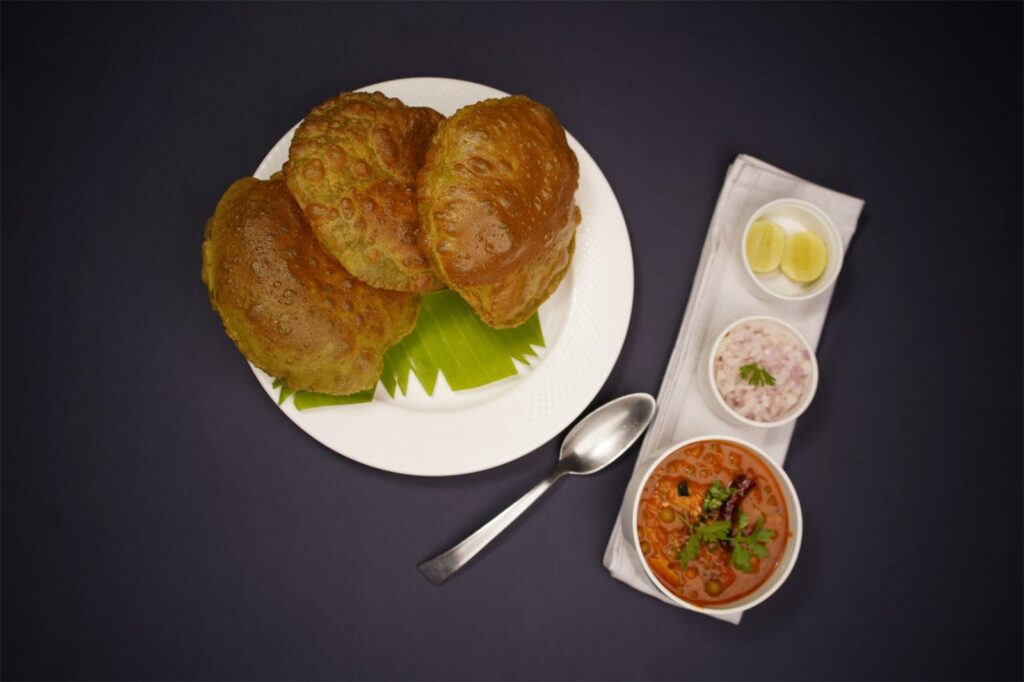
Puri vs bhatura: side by side
| Feature | Puri (poori) | Bhatura (plural bhature) |
|---|---|---|
| Flour | Atta (whole wheat); some add semolina or white flour | White flour (maida or all-purpose); some add semolina |
| Leavening | None | Yogurt, with yeast, overnight fermentation, baking soda and powder, or Eno; sources differ |
| Dough | Stiff, short rest | Soft and stretchy; usually rests for hours |
| Size | About 4 to 7 inches | About 6 to 9 inches, round or oval |
| Texture | Thin, soft, a little crisp, nutty | Crisp outside, chewy and soft inside, tangy |
| Classic partner | Potato curry, chana, halwa, shrikhand | Chole, sliced onion, pickle |
| When | Breakfast, festivals, weddings | Breakfast, street food, weekend treat |
What is puri?
Puri is wheat flour, salt and water, rolled into small discs and deep fried, as Swasthi Shreekanth of Swasthi’s Recipes describes it. Wikipedia’s entry on puri as a food adds oil or ghee to the dough and says the flour is commonly atta. If your bag says whole wheat instead, see atta vs whole wheat flour.
The ingredients are close to roti, and the difference is the cooking: roti is toasted dry, puri is fried. Our paratha vs roti comparison covers the griddle breads made from the same flour. Many cooks add a little semolina so the puffed shape holds longer.

What is bhatura?
Bhatura is a North Indian fried bread made from a raised dough of white flour, yogurt and salt. Wikipedia calls it similar to naan in its dough, and The Hindu’s Vasundhara Chauhan, cited there, says it comes either thick and spongy or very thin like a large puri.
Shreekanth ties it to Punjab and Uttar Pradesh and later to the streets of Delhi. Kneading until the dough is elastic is what gives the chew, per the same page. US cooks can use all-purpose flour; maida vs all-purpose flour explains how close the two are. For the tandoor breads made from similar dough, see naan vs roti and kulcha vs naan.
Is bhatura made with yeast?
Sometimes. The rise is the part sources disagree on most:
- Any of several: Shreekanth’s bhatura made without yeast page says the traditional way is an overnight ferment, that some recipes use yeast, and that modern ones use baking soda, baking powder or Eno (fruit salt) to save time.
- Yogurt and yeast: Wikipedia’s puri entry says bhatura has yeast and yogurt in the dough.
- Sourdough style: its bhatura entry describes yogurt fermentation, with yeast typical and baking soda as an alternative.
Puri has none of these. If the bread on your plate is tangy and stretchy, it is a bhatura.

Frying: oil temperature and time
Both need hot oil, because a cool pan means greasy, flat bread. Wikipedia gives two ranges for puri: about 30 to 40 seconds at 390 to 430°F, or 60 to 180 seconds at 360 to 370°F. The cooler range leaves more room for error on a home stove.
For bhatura, Shreekanth gives a test rather than a number: a bit of dough should rise at once without browning. Shreekanth also says that a bhatura that collapses after frying means the flame was too low. Use a deep, heavy pot filled no more than half full, and slide the bread in from the side. Fried snacks follow the same oil rules, explained in why pakoras turn soggy.
Why does puri not puff up?
Usually the oil is too cool, or the dough is too soft, too thin or too thick. Puri puffs because moisture turns to steam and pushes the two sides apart. Common causes, from Shreekanth and Piping Pot Curry:
- Soft or sticky dough: it drinks oil. Puri dough should be stiffer than roti dough.
- Cool oil: a pinch of dough should rise immediately.
- Uneven or wrong thickness: too thick stays flat; too thin turns hard.
- Pressing too hard: a light press with the slotted spoon helps, but a hole lets the steam out.
Steam puffs flatbreads on a dry pan too, and why a roti is not puffing up covers that version.

What do you eat with puri and bhatura?
Puri goes both ways, savory and sweet. Wikipedia lists potato curry (puri bhaji) and chickpea curry as the most common partners, plus shrikhand, aamras and halwa. Swasthi’s Recipes adds coconut chutney and vegetable kurma in the South.
Bhatura has one main partner: chole, with sliced onions and pickle. Chana masala vs chole explains which curry that is, and types of Indian curry has ideas for the rest of the table.
Luchi, kachori and pani puri
- Luchi: the Bengali cousin, made with white flour and ghee instead of atta. It is unleavened, so it is closer to puri than to bhatura.
- Kachori: often described as a stuffed puri, usually filled with pulses. It puffs less.
- Pani puri: crisp, hollow shells a bite or so wide, filled and dipped in spiced water. It is a chaat snack, not a dinner bread.

Puri or bhatura: which should you order?
- Want chickpeas and one filling plate: chole bhature, usually served with one or two large breads.
- Want breakfast or a lighter hand with potatoes: puri bhaji.
- Sharing several curries: puri, or a tandoor bread that keeps better.
- Avoiding dairy: ask. Bhatura dough normally has yogurt; puri may include ghee.
- Takeout: both deflate as they cool, so eat them in the restaurant if you can.
Frequently Asked Questions
What is the difference between puri and bhatura?
Puri is small, whole wheat and unleavened. Bhatura is larger, made with white flour and yogurt, and raised before frying.
Is bhatura made with yeast?
Some is. Other recipes rely on an overnight ferment, baking soda and powder, or Eno.
What do you eat with puri?
Potato curry and chickpea curry are the most common. Puri also goes with sweets such as halwa, shrikhand and aamras.
Is pani puri the same as puri?
No. Pani puri uses small, hard, hollow shells filled with potato, chickpeas and spiced water, while puri is a soft bread.
Why does puri not puff up?
The oil is too cool, the dough is too soft, or the disc is uneven, too thin or torn.
Is puri healthier than bhatura?
There is no general answer. Both are deep fried, and size, flour, oil and how many you eat change them more than the name does.
Next: another white-flour question, why naan turns hard.